
You may disagree with the claim that your process is not the problem. Most leadership teams do, at first. Here is why it may be worth reading in full, with an open mind.
- $1.18 billion in value delivered, and $3.5 billion in project value managed
- Eleven industries, nearly 100 companies, across twenty-five years
- COO and then interim CEO of a multi-site surgical group, profit up 230 percent
- Investment side of a twenty-three company portfolio
- A regional workforce of 1,800 recruited, trained and onboarded in six months, 1,528 retained
- An enterprise support backlog from thirty days to two, satisfaction up 58 percent
None of that came from a framework. All of it came from finding out what was actually happening, which is almost never what a company believes is happening.
Two divisions had to hand work to each other every day, and they had been failing to do it for a long time.
The story I was given before I arrived was clean, and everybody agreed on it. The handoff process was broken. It had been designed for a smaller company, patched more than once, and needed a proper rebuild. There was a project underway to do exactly that, and it was running well past the time it had been given.
Everyone I spoke to in the first days told me the same thing in slightly different words. The process. The system. The handoff.
When every person in a company gives you the identical explanation, unprompted, in the same phrasing, that is not consensus. That is a script.
What a script sounds like
There is a particular flatness to it. The words come out smooth, in the same order, with no hesitation, because the person has said them many times and has never once been challenged on it.
Real diagnosis does not sound like that. When someone is actually thinking about a cause they hesitate, they qualify, they contradict themselves halfway through and correct it. Smoothness is the tell. It means nobody is thinking about the question any more. It has been settled and everyone has agreed to stop looking.
So the useful question is never what is broken. Everyone will tell you that. The useful question is what would have to be true for that explanation to be wrong.
I ask a version of it in every conversation, and I ask it hardest of the people furthest from the executive floor.
Where the real answer lives
The people who see the cause most clearly are almost never the people paid to explain it to you.
Executives are structurally unable to see it, because the thing causing it is usually something they agreed to, hired, protected, or reorganised. Not through incompetence. Through proximity. You cannot audit a decision you made and still be the person who made it.
The people carrying the work see it perfectly.
Nobody says it directly the first time. What surfaces is a sentence that sounds like an aside. The handoff runs fine when a particular person is out.
That sentence was the whole engagement. Everything after it was confirmation.
What was actually happening
The process was not broken. It was being routed around.
There had been a reorganisation. One senior leader came out of it without the role he had held, and kept every relationship that role had given him. Work that should have moved directly between the two divisions was being diverted through him, because he was still the person who knew everyone, and because going around him created a conflict nobody wanted to have.
Every diversion cost days. The company was rebuilding a process people had already quietly decided not to use.
Here is what it actually was, underneath. It was his ego, and something more sympathetic than ego usually gets credit for. He needed to stay in the loop on something he was no longer part of. He felt inconsequential. And nobody had the heart to tell him no.
Every individual decision to route through him was kind and defensible. The pattern was the problem, and no single person could see the pattern from where they were standing.
Not sabotage. A hundred sensible local choices adding up to something nobody chose.
Why nobody had said it
Everyone knew. That is the part that surprises people, and it should not.
Several described it to me separately, each convinced they were telling me something confidential.
They had not said it out loud because saying it meant naming a specific person who had allies, history, and an unresolved grievance. The cost of naming it fell entirely on whoever named it. The cost of not naming it was spread across everyone, invisible, and charged to a process rebuild.
That is the arithmetic that keeps these things alive. Individually rational silence, collectively expensive.
It is also why the answer cannot come from inside. Anyone on the payroll who names it pays for it. I do not work there. No seat to defend, no relationship to preserve, nothing to sell afterward. I am the only person in the building who can say it at no cost to myself.
The part nobody expects
This is where most advisors get it wrong, and it is why this kind of finding usually damages a company instead of freeing it.
Naming it is the easy half.
Surface this without preparing the ground and you humiliate a man in front of an organisation. He leaves, or he stays and becomes something worse than a bottleneck. You will have been correct and you will have made the company weaker. Being right is not the job.
So before I said a word to him, I went to the CEO. Privately.
I asked why the reorganisation had happened. I said I sensed this leader felt put out and displaced, and asked whether that was fair. Then I told him the thing that mattered most.

Not equivalent value. Higher. Equivalent reads as a consolation prize and everyone in the building can see it for what it is, starting with him. It has to be something real to be accountable for, something that uses what he is genuinely good at, and something visibly worth having.
Because he was valuable. That was never in question. He had done nothing to deserve defacement. What he needed was a redirection of his skills, and what the company needed was to stop paying for the absence of one conversation.
I told the CEO he had to take the lead on the start of it. I would surface the problem and show the man what it was costing, and he would be taken aback, because he genuinely had not seen the pattern from inside it. But the CEO had to be immediately behind me, reinforcing his faith in him and putting the new thing in his hands.
He needed to save face. Not be spared the truth. Save face while receiving it.
Do you understand the difference? Almost nobody does, and it is the whole reason this work holds after I leave.
How the conversation went
Not in a room full of people. That is a mistake I have watched other advisors make, and it produces a defensive reaction that sets everything back weeks.
I said it to him alone. I showed him what the routing was costing, in days, and in a year of project spend aimed at something that was not the problem. He was taken aback. Anyone would be. Nobody had told him, because everyone had been protecting him from it, and that kindness had cost the company more than the truth ever would have.
The cut is aimed at the problem, never the person. That is not softness. It is the only way the room can hear it. The moment it becomes about who is at fault, everyone starts defending and nothing moves.
Then the CEO was right there, exactly as we had agreed, with something better in his hands.
What changed
The routing stopped, because the reason for it stopped.
The rebuild was never the fix. The process worked once people stopped going around it. The reorganisation that had been sitting half-finished got finished properly. He took on something that used what he was actually good at, and the trust between him and the CEO was repaired rather than broken.
What the company saved was not the project cost. It was the years it had spent explaining a problem to itself instead of resolving it.
What to look for in your own company
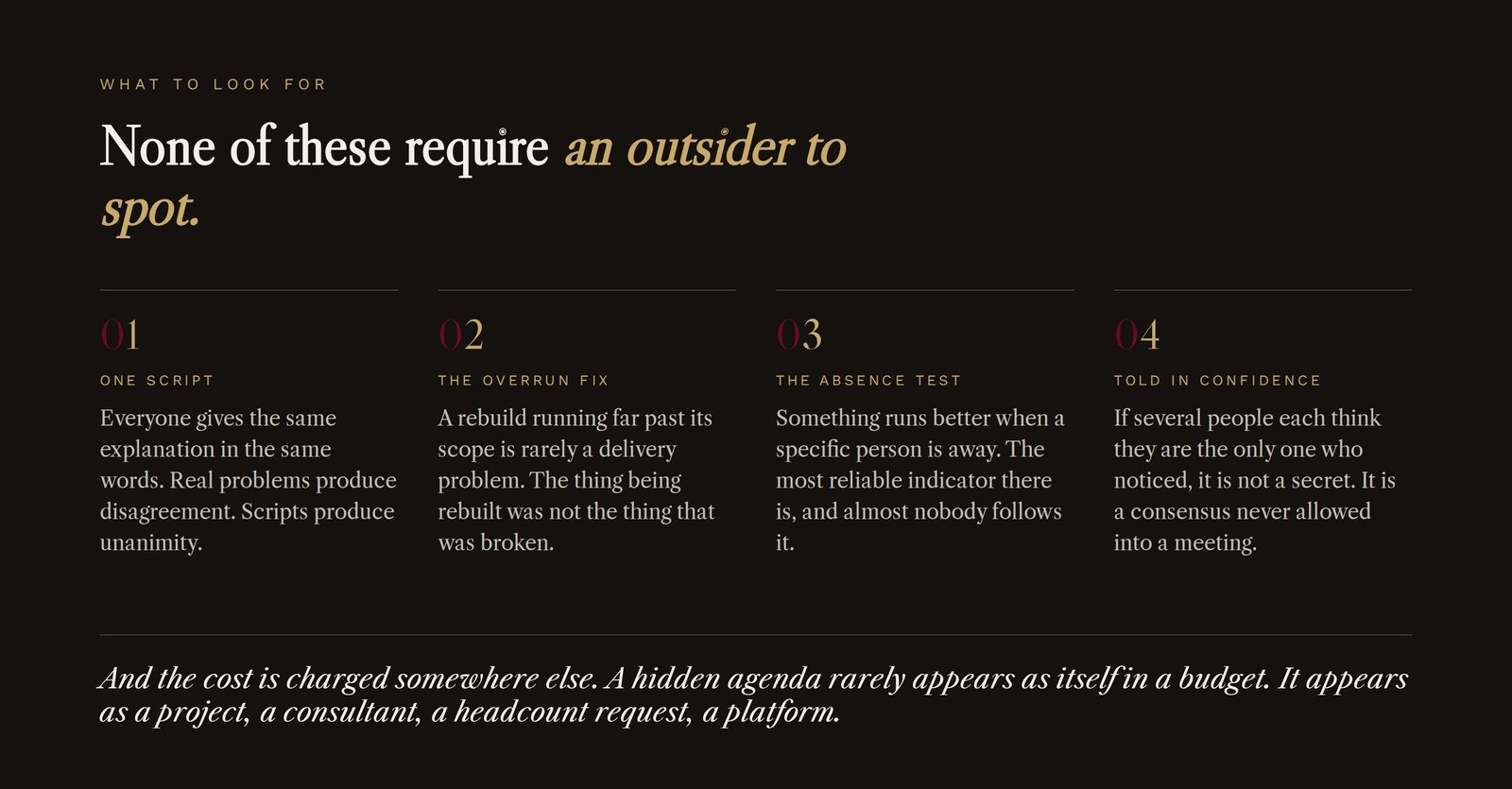
None of these require an outsider to spot.
Everyone gives the same explanation in the same words. Real problems produce disagreement about causes. Scripts produce unanimity.
The fix has been underway longer than it was scoped to take. That is rarely a delivery problem. It usually means the thing being rebuilt was not the thing that was broken.
Something runs better when a specific person is away. The most reliable indicator I know, and almost nobody follows it, because the conclusion is uncomfortable and the observation feels like gossip.
People tell you confidentially. If several people each believe they are the only one who has noticed, it is not a secret. It is a consensus that has never been allowed into a meeting.
The cost is charged somewhere else. A hidden agenda almost never appears as itself in a budget. It appears as a project, a consultant, a headcount request, a platform.
The pattern underneath all of it
The how is never the issue.
Process, tooling, structure, those are almost always solvable and usually solvable fast. What holds a company still is an agenda that cannot be discussed, and every person who can see it has a reason to stay quiet.
The company then spends real money treating the symptom, because treating the symptom is the only option that does not require anyone to say the true sentence out loud.
My job is getting that sentence said in a way that leaves everyone able to stay in the room afterward. Which makes the diagnosis about a third of the work. The rest is making sure the person at the centre of it comes out holding more than he went in with.
Nothing is sacred. Everything is protected.
Once it is out, the fog clears fast. It always does. The answer was in the building the whole time, sitting inside people who could not afford to be the one who said it.