You may disagree that someone inside your company could be working against the fix. Nearly everyone does, until they see it. Here is why it may be worth reading in full, with an open mind.
- $1.18 billion in value delivered, and $3.5 billion in project value managed
- Eleven industries, nearly 100 companies, across twenty-five years
- COO and then interim CEO of a multi-site surgical group, profit up 230 percent
- Investment side of a twenty-three company portfolio
- Raised capital, and advised investors against putting capital in
- Resort and infrastructure development early in my career, through to enterprise software
I have watched this exact pattern in every one of those eleven industries. It is the same failure each time, wearing local clothes.
I was not brought in to fix any equipment. I was brought in to raise money.
The company needed a second round and the existing investors were not participating. That was the assignment. Build the case, make the pitch, close the round.
So before I wrote anything, I went and asked the current investors why they were not putting more in.
That is not a difficult move and almost nobody makes it. The people who will tell you what is actually wrong with a company are frequently sitting outside it. They have no job to protect, no colleague to avoid embarrassing, and no reason to hand you the version everyone inside has agreed on.
They were not vague. The company was missing its milestones and could not produce at volume. Until that changed there was no conversation to be had about a second round.
That answer sat upstream of everything I had been hired to do. There was no fundraise to run. There was a production problem wearing a fundraise costume.
What had happened
They had bought used equipment, imported it, and retrofitted it for their own technology. It broke the first time they ran it at volume.
That was when they discovered the manufacturer no longer supported the machines. The parts that failed were described to me as unavailable. Proprietary, discontinued, unsupported by anyone. Every route to a replacement had been checked and closed. The capital was already spent.
By the time I arrived this had become the entire story of the company. Every conversation ran through it. Every plan waited on it. There were people whose whole working week was organised around a problem that had been declared unsolvable, which is a strange and particular kind of exhaustion.
We still had the broken pieces.
That is the detail I keep returning to, and it is the one that says the most about how companies get stuck. The failed parts were not missing. They were sitting right there in the building, in hand, the whole time. Anyone could have carried one out to a firm that does replication work and asked whether it could be reproduced.
Nobody had. The manufacturer had stopped supporting the machines, and unsupported by the manufacturer had quietly become unobtainable, and then simply impossible. Each step was a small and reasonable one. Nobody made a mistake. But at some point it stopped being a question and became a fact, and once something is a fact nobody goes looking.
The evidence that the story was wrong was physically present in the building for the entire period the company was failing because of it.
What I was actually hired for
Sit with the brief for a second.
The company could not hit its milestones. The investors had said so directly. And the response was to bring in someone to build a compelling case and go raise money anyway.
I was not hired to find out why the milestones were being missed. I was hired to put lipstick on the pig and dance it out like a grand champion.
That happens constantly, and the person it happens to is usually the last to see it. A new hire arrives, or an advisor, or a consultancy, and everyone believes the brief. Solve this. Build the case. The actual purpose is legitimacy. Someone external is needed to say the thing the company has already decided, in a voice with no history attached, so it can be repeated to a board or an investor or a market.
The rock gets a fresh coat of paint and a credible stranger to vouch for it.
I vet for this now, quickly, and I am accurate about it. A few questions do most of the work.
What has already been tried, and what happened? If the honest answer is a series of efforts that all stopped short of the same point, that point is the real subject.
Who disagrees with this brief, and what do they say? If nobody disagrees, either the brief is trivially correct or dissent has already been priced out of the room.
What would have to be true for this problem to be permanently gone? Ask four people. If nobody can answer, nobody has been permitted to look.
Who wants me to succeed, and who does not? Somebody always does not. The useful question is why, and it is almost never about competence.
I took the engagement. I just did not take the brief.
The curse was gravity
Everyone remembers Sisyphus for the boulder. Almost nobody remembers what he did to deserve it.
He betrayed Zeus. He gave up a secret that was not his to give, then cheated death twice to avoid the consequences. The endless labour was never a punishment for being unproductive. It was the aftermath of a betrayal.
And look at the mechanics of the curse. The hill is not the problem. The rock is not the problem. What returns that rock to the bottom every single time is gravity. Invisible. A constant hand. Acting on the stone every second, and on the man, and on the mountain itself.
You cannot out-push gravity. Nobody has ever been strong enough and nobody ever will be.
Until Sisyphus acknowledges the betrayal, he stays chained to a thing he created himself. That is the whole architecture of the curse. It is not the gods holding him there. It is the one sentence he will not say.
And if betrayal were so easily forgivable, Lucifer would still be sitting at the right hand of the Divine.
That is the shape of every stuck company I have walked into. There is a rock everyone agrees on and pushes at, and there is a force nobody has identified quietly returning it to the bottom, and somewhere underneath all of it there is usually something that has never been said out loud.
Sometimes that force is structural. Sometimes it is a decision nobody will revisit.
And sometimes, more often than anyone writes about, it is a person.
The betrayal is usually hidden
I want to draw a line here between two situations that look similar and are not.
In one, everybody already knows. The thing is an open secret and nobody will say it out loud, because naming it costs whoever names it. Getting it into the room is the entire job.
This was the other kind. Nobody knew.
The betrayal was concealed underneath strawmen and what looked like conscientious concern. It presented as prudence. It presented as someone asking hard questions about cost and quality and risk, which is precisely what a responsible founder should be doing. Not one person in that building suspected anything, and none of them were fools.
That is what hidden agendas look like when they are done properly. They do not look like agendas. They look like care.
I sensed it before I could prove it, and I want to be careful about how I say that. I did not have evidence. I had a pattern that did not sit right, and a conviction that arrived well ahead of anything I could put in front of another person.
Which is exactly why the next thing I did was go and get the facts and the numbers. A sense is not something you can act on and it is certainly not something you can say out loud. It is a reason to go looking.
Nobody had any reason to trust me
This is the part people skip, and it is the part that made everything else possible.
I was an outsider, brought in to raise money for a broken company, with no history and no standing. Nobody had any reason to believe me about anything. If I had walked into a room in week two and suggested that one of the founders was working against the business, I would have been gone by the end of the day, and I would have deserved to be.
You cannot confront from a position of no legitimacy. You have to build it first, and it has to be built out of things that are objectively verifiable by people who are not you.
So that is what I did.
First, the technical question, answered by people who were not me. I researched twelve firms and shortlisted three. Not machine shops. Full companies that did replication work daily, held the tolerances involved, and warrantied their output. The warranty is the filter. A company willing to guarantee the part is a company that has told you the truth about whether it can make it.
Then I put them in the room and let them answer the questions directly. Tolerance, materials, method, timeline, and what happens if a part fails. In writing, with guarantees attached. I did not argue any of it, because I was not the right person to and pretending otherwise would have been the fastest way to lose.
Second, the value question, answered by people who were not me. I brought in the venture investment arm of a major instrument manufacturer to independently assess the technology and the production capacity, and to put a real number on it.
That mattered more than the number itself. The technology was genuinely valuable. They had something difficult and expensive to produce, and they could do it cheaply and reliably, which is a rare combination and the whole reason I had taken the engagement in the first place. An outside assessment said so, in writing, from a party with no interest in flattering anybody.
That restored something the company had lost, which was any belief that it was worth saving.
And it did something else. It told the CEO and the co-founder that my focus was the highest and best outcome for the business, because everything I had brought them was independently verifiable and none of it required them to take my word.
Only then did I have the standing to surface who was betraying them.
You must have the facts and the numbers. Not because the truth needs decoration, but because nobody will let you say it without them.
The objections that would not stop
When I proposed reproducing the parts, one of the founders fought me. Tooth and nail, for weeks.
Every objection was reasonable on its own. Cost. Quality. Timeline. Whether an outside firm could hold tolerance on parts like these. Whether it was worth the disruption.
The three companies answered all of it. In the room, in writing, with warranties.
And another objection arrived the following week.
That is what resistance looks like from the inside. It never presents as I do not want this solved. It presents as diligence. The way you tell the difference is that diligence is satisfiable. When the experts have answered everything with guarantees attached and a fresh concern appears anyway, you are no longer looking at caution.
Those objections were the emperor's new clothes.
Everyone in the room treated them as real garments. Not because anyone was fooled, but because saying those are not actual concerns makes you the unreasonable person in a meeting where someone senior is asking careful questions. So the questions kept their status, week after week, and the company kept losing days to them.
That is the whole mechanism of the fairy tale and it is worth being precise about it. The emperor's vanity is what the swindlers exploit. The court's fear of looking foolish is what keeps the illusion standing. And the only person who can say it is a child, who holds no position and therefore has nothing to lose by speaking.
I am usually the child in that story. Not because I am wiser than anyone in the room. Because I am the only one whose standing does not depend on going along with it.
And then think about what the emperor is left with once he is standing there clean.
He was betrayed twice. The swindlers took his money and handed him nothing, which is the betrayal everyone remembers. The second one is worse and nobody talks about it. Every person in that court could see he was bare. Not one of them told him. They watched him dress in nothing, walk out of his own palace, and parade through his own streets, and they let it happen because each of them had calculated that speaking would cost more than his humiliation would.
That is the betrayal that lands when the illusion drops. Not the con. The silence of everyone who knew.
I have watched leaders arrive at exactly that realisation. The moment is never really about the person who was working against them. It is the discovery that the people around them saw it, and said nothing, and called it loyalty.

What he actually wanted
He wanted out.
He was burnt out and had no intention of continuing, and he wanted an equity buyout. But he wanted the company valued low when it happened. Low enough that someone he knew could step in at a fraction of what the business was worth and take the technology with them.
Look at what he was arguing for instead of the repair. He wanted the company to raise more money and buy new equipment.
Follow that through. Raising into missed milestones means raising at a depressed valuation, which dilutes everyone. New machines mean months of procurement, import and retrofit, extending the period of not producing. Every element of that path kept the number low and the clock running.
The repair did the opposite. Thirty days, back ordered contracts filled, revenue already sold and waiting, milestones met, and a company that suddenly looks like what it actually is.
I am not going to tell you what was in his head. I can tell you what his position would have achieved, and that he was the only person in the building arguing against the cheapest and fastest way out of a hole.
The confrontation
I have no difficulty confronting anyone, anywhere, at any time.
I understand why that reads as reckless and it is the opposite. It is only available to someone with nothing at stake, and I had nothing at stake. My retainer was already being paid. I held a stock position worth nothing at the time, which would only become worth something if the company recovered, which was the outcome he was blocking. I was not protecting a thing.
I chose the room deliberately. Him, the CEO, the co-founding partner, and me. Nobody else.
Not in front of the company, which produces a defence rather than an answer and turns a solvable problem into a public war. But in front of the two people he was actually betraying is a different proposition entirely. Everything he had been saying worked perfectly well in a project meeting. It did not survive being said to his partner's face.
This is a poker table more than a courtroom. Sometimes calling the bluff is the correct move. You go all in, you find out what he is actually holding, and you pick the moment when the cards have to be shown to the people who matter.
I asked him why he actually wanted to dilute his own position here.
Then I put the arithmetic on the table, because the arithmetic was the argument. A thirty day route to filling the back orders. Revenue already contracted. Milestones met, which was the only path to the round I had been hired to raise. Profit on the other side of it. And him, fighting not just me but everyone in the building.
I told him he was going to answer me right there, in that room.
There is no good answer to why do you want your own company valued lower. That is the point of the question. It requests an explanation that does not exist, and the absence of one was witnessed by the two people whose belief in him was the only thing his position depended on.
He sat down, shocked, and stopped.
The parts were made. The equipment ran. The back orders were filled.
He did the rest himself
I never had to do anything to him.
People imagine that surfacing something like this requires a campaign afterwards. It does not. He damaged his own standing, in one room, by having no answer to a fair question in front of his partner. Everything that followed came from the CEO, not from me.
That is generally how it goes. I do not have to make anything happen to someone who has been working against his own company. I only have to make it visible to the person with the authority to respond, and then get out of the way.
Why I move fast on the stated problem
Solving it quickly is a test, and this is the part that gets mistaken for showing off.
If a thing everybody called impossible falls over in a month, it was never the real constraint. And once it is gone, whatever it was covering is standing in plain sight.
While the rock is there, every unresolved thing in the company can be attributed to the rock. We cannot address that until the machines run. We cannot have that conversation while this is going on. The rock absorbs blame for everything, which is precisely why some part of the organisation is comfortable with it and would rather it stayed.
Removing the rock is what makes the gravity visible.
Getting off the hill
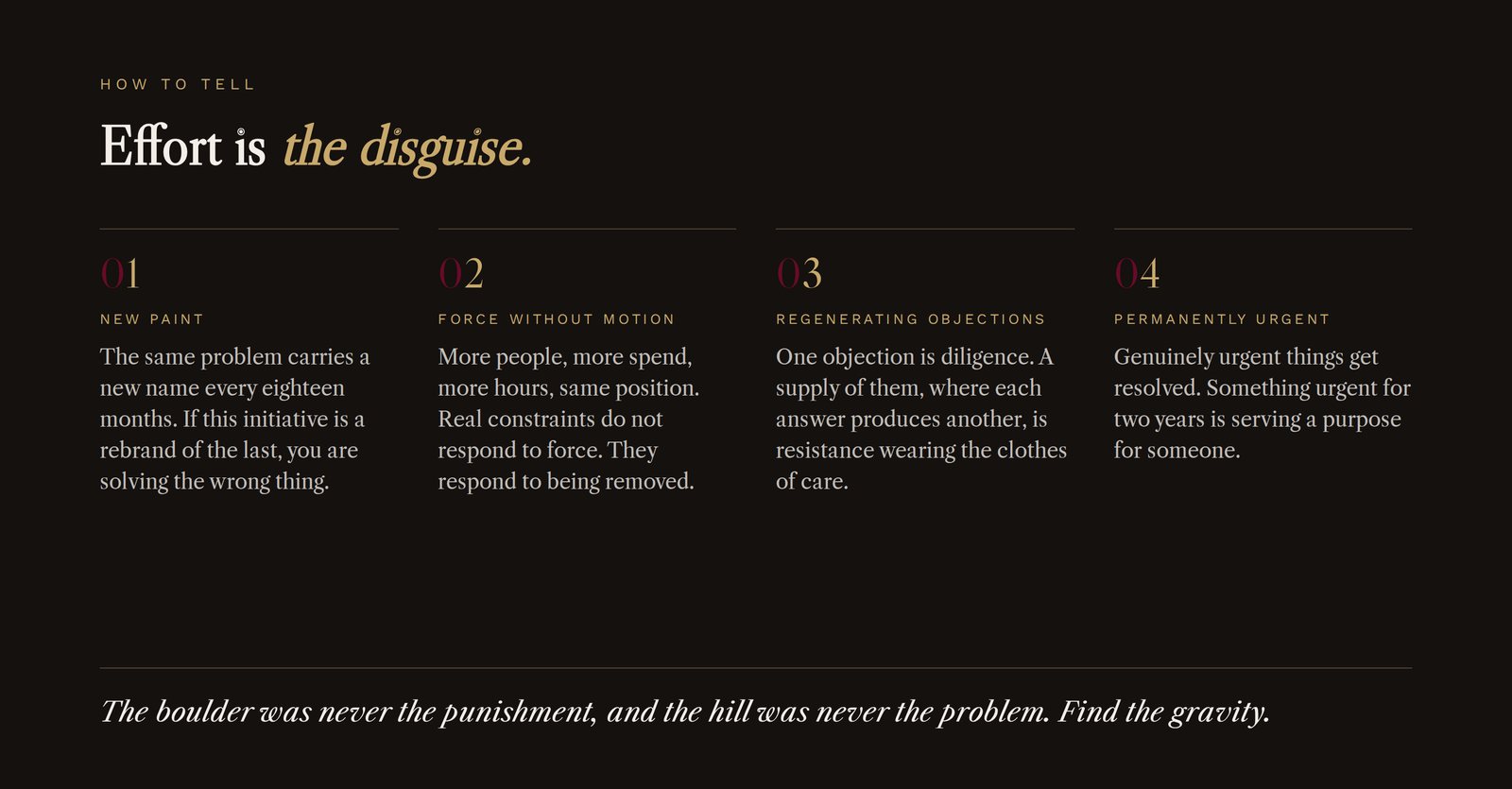
Solve the stated problem, or prove it unsolvable, and do it fast. Either result is useful. The permanent middle state, neither fixed nor abandoned, is where most companies live and it is the most expensive place to be.
Look immediately at what is still standing. That window lasts about a fortnight before a new rock is nominated. Something will step forward to absorb the attention. Do not let it.
Build legitimacy before you name anything. Get facts that are verifiable by people who are not you. Bring in outside expertise that answers directly rather than through you. Nobody will let you say the difficult thing without them, and you should not expect them to.
Ask the question privately, in front of the one person with authority. Not in a meeting, not in a report. Ask why they want the outcome their position produces. There is often no answer, and the absence of one, witnessed by the principal, does more than any accusation.
Then get out of the way. Consequences that arrive from inside the company are the only ones that hold.
The boulder was never the punishment, and the hill was never the problem. Find the gravity.
Part two
Part two looks at the same force operating in companies where nobody is working against anything at all. Those are more expensive, and nobody gets blamed for them either.
Part two arrives with Chaos to Ease, my newsletter and podcast.
Subscribe to Chaos to Ease